Modern Legal Drafting
Document must be read as a whole
Turning now to the internal principles of interpretation: the first to be con- sidered holds that the document (or series of documents, if the transaction is to be carried out by a series) should be construed as a whole. As Viscount Symonds said in Attorney General v Prince Ernest Augustus of Hanover, ‘no one should profess to understand any part of a statute or of any other doc- ument before he has read the whole of it. Until he has done so, he is not entitled to say that it or any part of it is clear and unambiguous.’49
Ejusdem Generis
Ejusdem generis is latin for "of the same kind." When a law lists lists classes of persons or things, this concept is used to clarify such a list.
For example, if a law refers to automobiles, trucks, tractors, motorcycles, and other motor-powered vehicles, a court might use ejusdem generis to hold that such vehicles would not include airplanes, because the list included only land-based transportation.
In Circuit City Stores Inc., v. Adams, 532 U.S. 105 (2001), the Supreme Court defined ejusdem generis as a situation in which "general words follow specific words in a statutory enumeration, the general words are construed to embrace only objects similar in nature to those objects enumerated by the preceding specific words."
Limits of Ejusdem Generis
The dissent in Adams, however, stated that when there are good reasons not to abide by ejusdem generis, then a court will set aside its use.
Further, the Supreme Court stated in N. & W. Ry. v. Train Dispatchers, 499 U.S. 117 (1991) that ejusdem generis does not apply "when the whole context dictates a different conclusion."
The Doctrine of Ejusdem Generis in Missouri
Several definitions of the ejusdem generis rule have been o:ffered. One of the most clear, concise, and correct is that formulated by the Missouri Supreme Court in State 'V. Eakhardt:1 ... where general words follow the enumeration of particular classes of persons or things, the general words will be construed as applicable only to persons or things of the same general nature or class as those enumerated. The rule is based on the obvious reason that if the Legislature had intended the general words to be used in their unrestricted sense they would have made no mention of the particular classes...The doctrine of ejusdem generis, however, is only a rule of construction to be applied as an aid to ascertaining their legislative intent. 2 The converse is, of course, also a part of the general rule. That is, when general words follow the enumeration of particular classes of persons or things, the general words will ordinarily be deemed to bring those objects of the same general class as those enumerated within the purview of the statute. However, the doctrine is ordinarily stated in the negative, the affirmative aspect being implied
In the Eckhardt case the defendant was found to have violated a statute which read as follows:
If any father or mother of any child under the age of six years, or any other person to whom such child shall have been confided, shall expose such child in a street, field or other place with intent wholly to abandon it, he shall ... upon conviction 3
The defendant claimed immunity from criminal liability under the ejusdem generis rule, since she abandoned the child in ques tion in a street railway station, a location concededly not ejusdem gen.eris with a street or field. The court, over-ruling defendant's contention, held the rule inapplicable and affirmed her conviction. It said that the "great fundamental rule in the interpretation of statutes is to ascertain and give effect to the intention of the Legislature,"" and that here the legislators certainly intended a person occupying the status of the defendant to come within the purview of the statute.
The Eckhardt case serves a two-fold function. It affords a clear definition of the ejusdem generis rule, and at the same time points out that the doctrine is only to be used as an aid in ascertaining legislative intent. It will be disregarded if to apply it would contravene that intent. Keeping these two propositions in mind, we shall now discuss those cases in which the Missouri courts have made use of the ejusdem generis rule.
Exceptions
It is well established that the ejusdem generis rule is not one which will be arbitrarily applied in all cases. Rather, it is to be used only as an aid in ascertaining and giving effect to legislative intent. When the doctrine will not serve this valuable function, the courts will not employ it.
Two basic types of situations will occur in which the courts will refuse to apply the principle. First, the court may find itself faced with a situation wherein the person or thing sought to be brought within the purview of the statute is in fact ejusdem generis with the specific persons or things enumerated there, and yet the court might feel that to hold the statute applicable would defeat the legislative intent. In such a case, the court will not apply the doctrine and will hold the statute inapplicable. The second instance in which the doctrine will not be applied is the converse of the first, i.e., a situation where the person or thing involved is clearly not of the same general class as those things specifically enumerated in the statute, but where, nevertheless, the court feels the legislature intended that the statute apply to this person or thing.
There have thus been developed some fairly well-defined exceptions to the ejusdem generis rule. These are clearly and concisely set out by the Missouri Supreme Court in State v. Eckhardt.32
The doctrine of ejusdem generis, however, is only a rule of construction to be applied as an aid to ascertaining the legislative intent, and does not control where it clearly appears from the statute as a whole that no such limitation was intended. Nor does the doctrine apply where the specific words of a statute signify subjects greatly different from one another; nor where the specific words embrace all objects of their class, so that the general words must bear a different meaning from the specific words or be meaning less.33
There are, then, at least three instances in which the rule will not be employed by the courts. These will be discussed in the same order in which they appear in the above quotation.
Legislative Intent Governs
It should be pointed out that the courts often confuse the real issue here. They sometimes say that they are not applying the rule when actually it could be argued that the thing or person involved is, in fact, ejusdem generis with the things specifically enumerated. Whatever the reasoning used, however. the follow ing decisions hold that the particular statute does or does not apply to the person or thing involved on the sole ground that the legislature did not intend that it should. The courts wholly disregard the question whether the person or thing sought to be brought within the purview of the statute is efusdem generis with the persons or things specifically mentioned therein.
Thus in the Eckhardt case, the Missouri Supreme Court held the defendant criminally liable for abandoning a child in a street railway station, under a statute which imposed liability when a child was abandoned in a "street, field, or other place."34 The court admitted that perhaps a street railway station was not of the same class as the places specified, but affirmed the de-fendant's conviction on the ground that the legislature certainly intended to include the acts of the particular defendant.
Specific Words Signifying Different Classes
Where the specific words employed in the statute signify sub jects greatly different in nature from one another, the ejusdem gen.eris rule will not be applied.
Specific Words Which Exhaust the Class
Another instance in which the ejusdem generis rule will not be employed arises when the things specifically enumerated exhaust the class to which they belong. In such a case, it is thought that the general words which follow the specific enume rations must relate to other classes of persons or things. Other wise, why would the legislature have used the general words? One case exemplifying this exception to the rule is State 'll. Smith.42 There a statute provided:
It shall be unlawful for any person not now a registered physician within the meaning of the law to practice medicine or surgery in any of its departments, or to profess to cure and attempt to treat the sick and others affected with bodily or mental infirmities….
The defendant was a chiropractor and claimed that he did not "practice medicine or surgery'' within the meaning of the statute. He said that he merely "adjusted" difficulties which arose as a result of some spinal disorder and did not "cure." Holding defendant responsible under the statute, the Missouri Supreme Court declared:
. . . this rule of ejusdem generis is, after all, resorted to merely as an aid in construction. If, upon consideration ... it is apparent that the Legislature intended the general words to go beyond the class specifically designated, the rule does not apply. If the particular words [here 'to practice medicine or surgery'] exhaust the class, then the general words must have a meaning beyond the class or be discarded altogether. Certainly here the words 'medicine or surgery in any of its departments' exhaust the genus or class.44
The Smith case shows clearly a legislative enactment in which there was a clear intent to regulate anyone who professed to cure the sick.
-------
Expressio unius
expressio unius est exclusio alterius n
[New Latin, the explicit mention of one (thing) is the exclusion of another]
: a
principle in statutory construction: when one or more things of a class are expressly mentioned others
of the same class are excluded
Under this rule of construction, express reference to one matter indicates that other matters are excluded. The rule is embodied in the maxim expressio unius est exclusio alterius – the expression of one thing is the exclusion of the other. Where parties have included express obligations in a document, a court is wary about extending those obligations by resort to implication. The presumption is, that having expressed some, the parties have expressed all of the conditions by which they intend to be bound under the document.65 The expressio unius rule becomes particularly relevant where a document lists specific matters but omits others that might be thought to be relevant. The rule presumes that the omission was deliberate. This has a certain logic to it. For instance, where a contract lists a number of events that entitle a party to set the contract aside, it seems reasonable to assume that the list is intended to be complete and that no other event will entitle the party to set it aside.
Noscitur a sociis
This rule can be expressed as follows: the meaning of a word or phrase can be controlled by the words or phrases associated with it. The Latin tag from which it is drawn can be translated: ‘it is known by its neighbours’. Stanley Robinson treats the rule as part of the general principle that documents are to be read as a whole.70 Most commentators, though, regard the rule as having a life of its own.71 In reality, this rule – like the others – is simply part of a general store upon which courts draw to give meaning to a document in the face of the parties’ differing interpretations.
An English case clearly illustrates the operation of the rule. An insurance policy taken out by a fruit and vegetable importer was expressed to cover ‘physical loss or damage or deterioration’ arising out of strikes. A dock strike delayed the arrival of the insured’s produce at market. During the period of delay, market prices fell, with the result that the produce fetched lower prices than it would have done had the strike not occurred. Was the loss in market price covered by the words ‘physical loss or damage or deterioration’? Pearson J held that it was not, applying the noscitur a sociis rule. Each of the three listed misfortunes involved physical damage to the produce – physical loss, physical damage, physical deterioration. The words did not extend to mere loss of market value.72
Just as the ‘genus’, or class, must be ascertained before applying the eiusdem generis rule, so the ‘societas’ to which the socii belong must be ascertained before applying the noscitur a sociis rule.73 This can be a diffi- cult exercise, on which different minds can reach different conclusions.74 Nevertheless, the rule is apt to trap unwary drafters.
Contra proferentem
Under the contra proferentem rule, if ambiguity in a clause or document can- not be resolved in any other way, the clause or document is construed against the interests of the person who put it forward
Golden rule 1: The ‘ordinary sense’ of words
This rule requires that words be given their ordinary sense. The meaning of an ordinary English word is not a question of law but of fact, to be found by taking into consideration all the circumstances of the case.92 Lord Macmillan explained this so-called ‘golden rule’ of interpretation:
The grammatical and ordinary sense of the words is to be adhered to unless that would lead to some absurdity or some repugnance or inconsistency with the rest of the instrument, in which case the grammatical and ordinary sense of the words may be modified so as to avoid that absurdity and inconsistency, but no further.93
Golden rule 2: Consistent terminology
This rule may be stated: ‘Never change your language unless you wish to change your meaning, and always change your language if you wish to change your meaning.’95 It could also be expressed along these lines: Different words are taken torefer to different things, and same wordsto same things.’ Like all rules of interpretation, it is applied only if the circumstances warrant.96
Lord Hoffmann’sprinciples
- Interpretation is the ascertainment of the meaning which the document would convey to a reasonable person having all the background knowl- edge which would reasonably have been available to the parties in the situation in which they were at the time of the
- The background was famously referred to by Lord Wilberforce as the ‘matrix of fact’, but this phrase is, if anything, an understated description of what the background may Subject to the requirement that it should have been reasonably available to the parties and to the exception to be mentioned next, it includes absolutely everything which would have affected the way in which the language of the document would have been understood by a reasonable man.
- The law excludes from the admissible background the previous nego- tiations of the parties and their declarations of subjective They are admissible only in an action for rectification. The law makes this distinction for reasons of practical policy and, in this respect only, legal interpretation differs from the way we would interpret utterances in ordinary life. The boundaries of this exception are in some respects unclear.
- The meaning which a document (or any other utterance) would convey toa reasonable man is not the same thing as the meaning of its The meaning of words is a matter of dictionaries and grammars; the meaning of the document is what the parties using those words against the relevant background would reasonably have been understood to mean. The background may not merely enable the reasonable man to choose between the possible meanings of words which are ambiguous but even (as occasionally happens in ordinary life) to conclude that the parties must, for whatever reason, have used the wrong words or syntax.
- The ‘rule’ that words should be given their ‘natural and ordinary mean- ing’ reflects the commonsense proposition that we do not easily accept that people have made linguistic mistakes, particularly in formal docu- On the other hand, if one would nevertheless conclude from the background that something must have gone wrong with the language, the law does not require judges to attribute to the parties an intention which they plainly could not have had.
WHAT TO AVOID WHEN DRAFTING MODERN DOCUMENTS
Overuse of ‘shall’
Shall is the hallmark of traditional legal writing. Whenever lawyers want to express themselves in formal style, shall intrudes. The word litters most precedent books, and finds its way into wills, conveyances, leases, and all types of contracts.
In traditional legal documents, shall serves many purposes. They include the following (with examples drawn from documents drafted in the tradi- tional style):
- To impose a duty: ‘The Distributor shall keep in good and saleable con- dition a stock of the ’
- To grant a right: ‘A purchaser shall have the right to cancel the purchase
- transaction until ’
- To give a direction: ‘The receipt of a person who appears to be a proper officer of the charity shall be a discharge to my ’
- To state circumstances: ‘The said restrictions shall be binding on the prop- erty hereby assured and the owner or owners thereof from time to time but the Purchasers shall not be personally liable for any breach thereof occur- ring after they shall have parted with all interest in the land in respect of which the breach shall ’
- To create a condition precedent (a ‘precondition’): ‘If the Vendor shall within one month of the receipt of such notice give written . .’
- To create a condition subsequent: ‘If in any circumstances my said intended marriage shall not have been solemnised within the period of six months from the date hereof then at the end of that period this my said will shall become ’
- To express the future: ‘The waiver of the observance and performance of the said covenant shall terminate on the disposal of the said ’ , the reference to access ‘on foot’ is strictly unnecessary, since a right of vehicular use includes a right of pedestrian use, permitting the grantee to walk along the roads as well as the footpaths: To negate a duty or discretion: ‘The Vendor shall not be bound to show any title to boundaries fences ditches or walls.’
- To negate a right: ‘Such statement shall be deemed to be correct and shallbe binding on the ’
- To express intention: ‘The said wall when erected shall be deemed to be a party ’
This list is not exhaustive. Like the categories of negligence, the categories of shall are not closed. Often, in the one document, shall serves a number of purposes. There may be a primary purpose, with subsidiary purposes; or two or three purposes may carry equal weight.
Courts usually construe shall as creating an obligation. Sometimes, though, they construe it as giving a mere direction
Separating parts of a verb
A particular source of difficulty is the device of widely separating two parts of a verb. Sense may well be lost, as in this clause:
In the event of any breach by the Cardholder of this agreement the Bank may in circumstances where the Principal Cardholder fails to comply or to procure compliance with the terms of a notice served by the Bank upon the Principal Cardholder require repayment in full of the outstanding balance on the Account.
The verb combination here is ‘may require’, but the modal auxiliary ‘may’ is separated from its associated main verb ‘require’ by twenty-seven words. The whole passage contains only fifty-three words, so the verb is split by more than half the total words – no wonder the reader is thrown. It would have been better first to state what the bank has power to do, and then to specify the circumstances in which it is entitled to exercise that power. The result would look something like this (stripping out the unnecessary capitals):
‘Hereby’
‘Hereby’ deserves special mention. Drafters in the traditional style have a particular affinity with it. Nothing is ever simply done; it is ‘hereby’ done. Presumably, the drafters consider that ‘hereby’ adds precision. But this is not always the case – ‘hereby’ can in fact introduce ambiguity. For example, in a New Zealand case a section in a statute gave landowners the right to compensation for loss or damage suffered from ‘the exercise of any of the powers hereby given’. Did hereby mean ‘by this section’, or ‘by this Part of the Act’, or ‘by this Act’? It took an appeal to the New Zealand Court of Appeal to decide that it meant ‘by this Act’.41
Nouns instead of verbs
Another linguistic convention is the use of noun phrases instead of verbs – the practice of ‘nominalisation’. This convention is not peculiar to legal writing; it also infects bureaucratic and official language. But in legal docu- ments it is endemic. For example, parties to legal documents don’t ‘decide’ to do something; instead, they ‘make a decision’. They don’t ‘resolve’, but ‘pass a resolution’. They don’t ‘sever’ a joint tenancy, but ‘effect a severance’. This practice of nominalisation might be thought to achieve a certain formality of tone, but it is at the expense of effective communication. Verbs, especially strong verbs, communicate more effectively. They help make writing more direct.
Overuse of the passive
Deeming
Stretched definitions
tretched definitions
Overuse of capitals
Provisos
‘Provisos’ have a long legislative history. For centuries in England, the term provided or provided that was used to introduce substantive provisions in legislation, as a contraction of the enacting formula it is provided [that]. This use has long ceased, but the term provided or provided that has survived, unique to legal writing. It has degenerated toa ‘legal incantation . . . an all- purpose conjunction, invented by lawyers but not known to or understood by grammarians’.83 To illustrate the points just discussed, consider the following clause from a lease of property in an earthquake zone:
The tenant must repaint the premises provided that if there has been an earth- quake the tenant must repair any structural damage.
Here the drafter has used the technique of proviso, not to qualify what has gone before, but to introduce an entirely new and stand-alone obligation. It would be better to delete the proviso and divide the clause into two independent parts:
The tenant must repaint the premises.
If there is an earthquake, the tenant must repair any structural damage.
HOW TO DRAFT MODERN DOCUMENTS
Document structure
The contents of a legal document should be ordered logically, to enable the document to be read and used quickly and effectively. As we explain below, by ‘logically’ we mean logically from the reader’s perspective. Each clause and paragraph should be presented in a way that is both sensible and comprehensible to the reader. Among other things, this requires that more important clauses should come before less important clauses. To illustrate, the general pattern of a contract might be:
- heading
- date
- parties
- definitions
- the heart of the deal
- things associated with the heart of the deal
- general housekeeping, such as
- duration
- assignment
- effect of death or dissolution
- what happens if things go wrong, such as
- bankruptcy or insolvency
- termination for breach
- liquidated damages
- dispute resolution
- standard provisions (‘boilerplate’), such as
- effect of extraneous events (‘force majeure’)
- service of notices
- governing law.
With the reader in mind, as a general rule each main clause should be limited to a single core concept. Combining two or more core concepts in a single main clause adds unnecessary complexity. For example, leases traditionally combined the demise (that is, the formal grant of the lease) and the reddendum (the obligation to pay rent), but the client would better understand the transaction if the grant of the lease and the rent obligations were in separate clauses. Similarly, it is helpful to separate concepts such as dispute resolution from notices relating to breach.
Examples
To illustrate issues of structure, consider a deed creating a partnership. The heart of the deal is the establishment of the partnership itself. Things asso- ciated with the heart of the deal are the nature of the business, the location of the activity, and the name of the firm. In a short document creating a straightforward relationship, the heart of the deal and things associated with it can be run together in one clause, thus:
The partners will carry on business in partnership as solicitors under the name Castle & Co, at 113 High Street, Hurstpierpoint, West Sussex, beginning on 1 January 2006 and continuing until brought to an end in accordance with this deed.
General, but essential, housekeeping matters should follow straight after- wards – like sharing profits or losses, providing capital, and the accounting year. Less crucial (but still important) matters might appear next – keeping bank accounts, who can sign cheques, and what drawings can be made. Boil- erplate comes last, for it may never have to be referred to if the agreement is performed in accordance with its terms. With a contract structure of this
kind, the parties can rapidly see what they are trying to achieve and how they are expected to achieve it.
Other types of document call for different provisions, but should be structured on the same principles. For example, a lease might take this form:
- the grant of the lease (the heart of the deal)
- rent and rent review (things associated with the heart of the deal)
- tenant’s covenants
- landlord’s covenants
- general housekeeping (for example, relating to services)
- early ending (for example, on damage or destruction)
- forfeiture for breach
- boilerplate, such as
- service of notices
- resolution of disputes
- interest on late payments.
Wills, too, can be structured in a way that regulates administration and distribution in a natural sequence. The structure could be:
- revocation of earlier wills
- appointment of executors
- gifts of particular items
- gifts of money
- distribution of residue
- powers of executors
- charging clause.
Definitions location- A third technique, aiming to capture the best of both worlds, is to begin or end the document with an index of defined terms, at the same time explaining that they are defined at other (specified) points in the document. This technique sometimes appears in legislation.37 It allows the reader to move fairly directly to the substantive provisions, forewarned that certain words and phrases have defined meanings but not yet burdened with the detail of those meanings.
Marking-One is to print defined terms in italics, a convention that some Australian parliamentary drafters now use. Another is to mark them with an asterisk, perhaps adding a running footer to the following effect: ‘Asterisked terms have defined meanings, to be found in clause X.’
Include Notes and examples
‘Shall’ and the modern document
In Chapter 5 we dealt with some of the interpretational difficulties caused by shall. We mentioned particularly the potential for imprecision the word raises in two contexts: the futurity/precondition division, and the obliga- tion/direction division.
Some modern writers still feel that shall has a place in legal documents. They distinguish between provisions that express a command and provisions that are merely directory. By directory they mean provisions requiring a certain course to be taken but imposing no sanction for breach – provisions that deprive the subject of an opportunity or right, but whose breach gives rise to no legal consequences. In the view of these writers, must should be used for directory provisions but shall should be retained to impose a command (mandatory).57
This view seems to be based on the premise that to use must for obligation leaves nothing distinctive for direction. Yet to prescribe shall for obligation and must for direction seems unnecessarilypedantic andas apractical matter invites trouble.58 It also overlooks the linguistic reality that in common speech shall is now used only rarely, and that where it is used it can have two quite different senses: to indicate compulsion (‘You shall shut the door’) or futurity (‘Tomorrow I shall shut the door’). To use it in legal documents can give rise to the same ambiguity.
Syntactic ambiguity
Problems with ‘and’, ‘or’
Drafting in the present tense
The modern technique is to draft in the present tense. This contrasts with the moretraditionalstyle, whichoftenadopts more complex tense constructions as if required for precision. However, documents generally speak in the present, and so it makes more sense to draft in the present tense. This makes for clearer, crisper drafting, and should never cause ambiguity. For example, traditional phrasing says:
- If the purchaser shall fail to pay, ..
- If the purchaser should fail to pay, ..
- If the purchaser shall have failed to pay, then . ..
But the modern drafter says:
- If the purchaser fails to pay, ..
The technique of drafting in the present tense is especially useful in simplifying the structure of definitions. For example, the traditional style says:
- In this agreement, residence shall include a house.
But the modern style prefers:
- In this agreement, residence includes a
================
Theoretical Syntax, ,
Recall: English has:
- VP (verb phrase) with a V head.
- PP (prepositional phrase) with a P head.
- NP (noun phrase) with a N head.
- CP (complementizer phrase) with a C
- TP tense phrase
- DP Determiner phrase
- Relativizer
Essentials of Linguistics
8.1 Tree Diagrams
8.2 X-bar Phrase Structure
9.1 Ambiguity
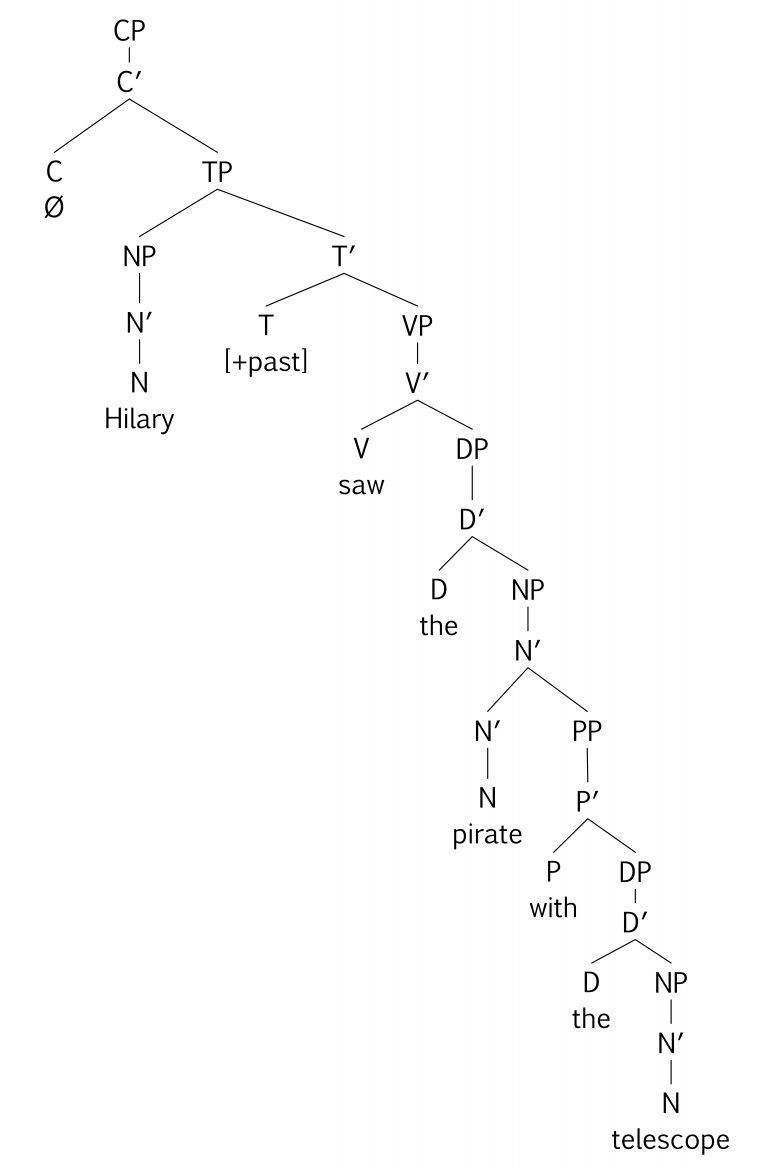
In some sentences, ambiguity arises from the possibility of more than one grammatical syntactic representation for the sentence. Think about this example:
Hilary saw the pirate with the telescope.
There are at least two potential locations that the PP with the telescope could be adjoined. If the PP is adjoined to the N-bar headed by pirate, then it’s part of the NP. (Notice that the whole NP the pirate with the telescope could be replaced by the pronoun her.) In this scenario, the pirate is holding a telescope, and Hilary sees that pirate.
But if the PP is adjoined to the V-bar headed by saw, then the NP the pirate is its own constituent, and with the telescope gives information about how the pirate-seeing event happened. In this scenario, Hilary is using the telescope to see the pirate.
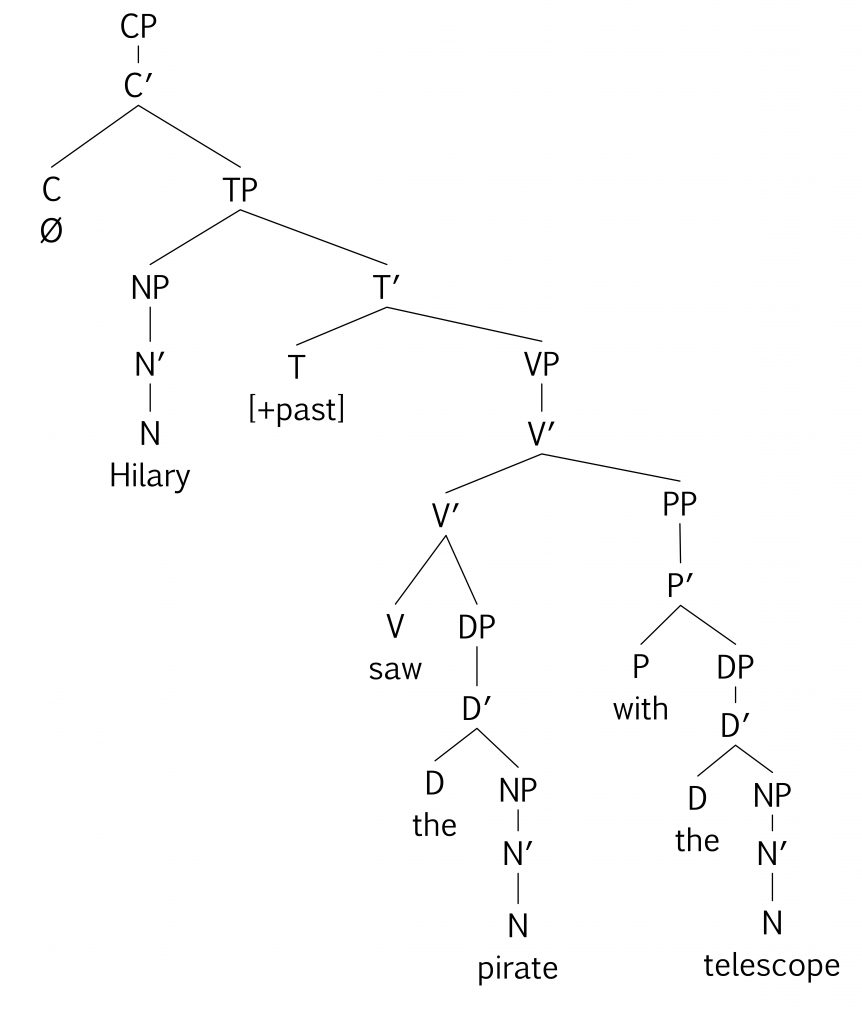
This single string of words has two distinct meanings, which arise from two different grammatical ways of combining the words in the sentence. This is known as structural ambiguity or syntactic ambiguity.
Another source of ambiguity in English comes not from the syntactic possibilities for combining words, but from the words themselves. If a word has more than one distinct meaning, then using that word in a sentence can lead to lexical ambiguity. In this sentence:
Heike recognized it by its unusual bark.
It’s not clear whether Heike recognizes a tree by the look of the bark on its trunk, or if she recognizes a dog by the sound of its barking. In many cases, the word bark would be disambiguated by the surrounding context, but in the absence of contextual information, the sentence is ambiguous.